
FLAT TAX PROPOSALS
Gregory Gethard writes for Investopedia (January 31, 2025)
Should the U.S. Switch to a Flat Tax?
Thanks for reading! Subscribe for free to receive new posts and support my work.
https://www.investopedia.com/articles/tax/09/flat-taxes.asp
Like in the U.S., most of the world's major economies have a gradual tax system that charges different rates for different income levels. In most cases, those who make the most money pay a higher percentage in taxes compared to those who make the least.
However, some countries use a completely different tax system: a flat tax system. With a flat tax, everyone pays the same rate.
Should the U.S. switch to a flat tax system? Review the potential pros and cons.
Key Takeaways
- A flat tax is a tax system where everyone pays the same tax rate, regardless of their income.
- While countries such as Estonia have seen their economies grow since implementing a flax tax rate, some say there is no proof that the tax system is the reason behind the growth.
- One drawback of a flat tax rate system is a lack of wealth redistribution.
- A flat tax may impose an added burden on middle and lower-income families or trigger tax rate wars with neighboring countries.
What Is a Flat Tax?
In many nations, governments have chosen to charge residents and businesses a flat tax so that everyone pays the exact same rate. Proponents of flat taxes tout several benefits, such as economic growth and fairness.
Many countries that have shifted to a flat tax were once in the Soviet Union. These countries saw their economies grow rapidly in the following years. As of 2017, Bulgaria, Estonia, Hungary, Latvia, Lithuania, and Romania had a flat tax. (In addition, the Czech Republic had a flat tax plus a 7% solidarity tax on gross income above a certain threshold.)1 And many of these countries that instituted a flat tax saw their economies grow significantly.
However, a wave of reforms has removed the flat tax system from various countries. In 2018, Latvia moved away from its flat tax and replaced it with a progressive system (20%, 23%, and 31.4%). In 2019, Lithuania began using a progressive system (20% and 27%). "In its original form, the flat tax is still maintained only in Bulgaria," wrote Simeon Djankov, Policy Director, London School of Economics and Political Science.2
Fast Fact
The reason why the flat tax works, according to proponents, is that the system is easy to understand.
Advantages of a Flat Tax
In many cases, not just individuals enjoy the benefits of an easy-to-understand tax code. Some nations grant flat taxes to businesses as an incentive to lure corporations and other employers.
In addition, proponents say the flat tax is fair, as everyone pays the same percentage of their income. This also helps to de-politicize tax codes as they are written since legislators cannot give preferences or penalties to firms and industries they regard either favorably or negatively.
Flat tax supporters often cite the nation of Estonia as proof of the system's benefits. Located between Russia and the Baltic Sea, Estonia has nearly 1.2 million residents.3 It's roughly double the size of New Jersey.3 In 1994, three years after separating from the Soviet Union, Estonian policymakers initiated a 26% flat tax, the first country in the world to move away from the gradual system.4 Estonia's flat tax is now 22%.5
Since instituting the flat tax, Estonia has become a member of the European Union. It has also earned the nickname "The Baltic Tiger" due to its incredible economic growth rate. From 2000 to 2008, Estonia's economy grew by an average of 7% per year.6
Downsides of a Flat Tax
While many countries that have adopted the flat tax have had booming economies, critics of the flat tax say there is no proof that the flat tax is the reason for the growth. After all, many of these countries were communist nations. Once the Soviet Union collapsed they were able to open up their economies to investment and could then trade with the developed countries in the West as freer markets.
In addition, critics say that a flat tax is unfair, as it doesn't allow for wealth redistribution.
A flat tax could also give middle-class families an extra burden. For example, if you make $1 million per year and you pay 18% in taxes, you would still net $820,000, which has great purchasing power. But if you made $50,000 per year, the same tax rate would net you $41,000 per year, which can be a financial strain.
In addition, when a group of countries near each other enact a flat tax, it can create competition to lower tax rates, which could lead to fiscal instability.
How Does a Flat Tax Benefit the Rich?
A flat tax means that wealthy people pay a lower tax rate than they would if the tax system included tiered rates. With much higher income, an individual will feel less of a burden with paying taxes. In contrast, a flat tax on people with lower and middle incomes would be more of a strain on their finances.
Why Is a Flat Tax a Good Idea?
A tax system with a flat tax rate is one that is easy to understand. Some say a flat tax system can lead to economic growth for developing countries.
Which States Have a Flat Tax?
The 14 states that had a flat tax as of 2024 include: Arizona, Colorado, Georgia, Idaho, Illinois, Indiana, Kentucky, Michigan, Mississippi, New Hampshire, North Carolina, Pennsylvania, Utah, and Washington. New Hampshire's flat tax applies only to interest and dividend income and Washington's flat tax only applies to higher earners' capital gains tax.
The Bottom Line
On the federal level, the U.S. has a tiered tax system. Though some believe the U.S. should switch to a flat tax system, it's unlikely that will happen any time soon.
REAL WORLD EXPERIENCE
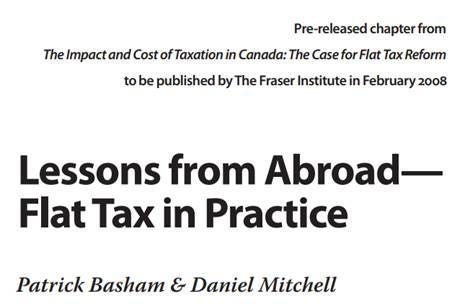
Basham and Mitchell contended in 2008:
https://www.fraserinstitute.org/sites/default/files/Flat_Tax_Lessons_From_Abroad.pdf
How does flat tax reform succeed?
The experiences of Central and Eastern European countries with the flat tax is a contemporary example of how radical tax reform can succeed (see Evans, 2007). What are the political and economic conditions that have resulted in successful implementation of a flat-tax policy in this region? Politically successful flat-tax proposals in Central and Eastern Europe shared the following five characteristics.
1 It is easier to implement simpler, more radical reform than more complicated, piecemeal reform. Slow and partial reforms do not work; fast and deep ones do work. (Economist, 2006, June 1)
2 The rate of a flat tax needs to be set at a comparatively low level.
3 The lower the ratios of tax to GDP and government spending to GDP, the better.
4 Though there may be a tipping point of complexity that leads to the “spasm of radical simplification,” the greater the number of current tax loopholes, the harder it is politically to introduce a flat tax, due to the entrenched resistance to change of special-interest groups. (Heath, 2006: 100–01)
5 Tax systems are often closely integrated with benefits or social security systems. Therefore, to avoid the benefits of radical tax reform being diluted, welfare reform ought to accompany tax reform to ensure that incentives to work and save are increased. Merely cutting taxes for some sections of the population may not increase incentives enough if the welfare system continues unchanged (Heath, 2006: 101).
Furthermore, researchers at the Harvard Business School conducted a case study of Slovakia’s introduction of the flat tax. Their research led them to conclude:
[T]he countries that have introduced a flat tax have all been in macroeconomic situations where something had to be done to foster growth and attract investments, which indicates a major trend for linking tax reform with, for instance, privatization and labor and welfare reforms. So existing evidence indicates that overhauling other parts of the public system, in order to afford a perceived cut in tax revenues through a flat tax implementation, is needed. This, however, does not indicate that the opposite is impossible. (Lagace, 2007)
Conclusion
A century ago, the New York Times editorialized against the introduction of the progressive income tax. In a warning that has stood the test of time, the newspaper cautioned that “[w]hen men get in the habit of helping themselves to the property of others, they cannot be easily cured of it” (Moore, 2007: A12). Today, progressive personal income tax rates make for a needlessly complex tax system. Increasingly, therefore, taxpayers ask if there is a realistic alternative to our wasteful, inefficient tax system. This chapter’s answer is a resounding yes. A realistic, proven alternative exists—the flat tax—and its successful international application threatens to relegate the Canadian tax system to a second division of national tax codes. The international flat-tax experience confounds Hettich and Winer’s cynical assertion that it is possible to have a flat tax, or to have democracy, but not both (Hettich and Winer, 2005). The most telling signal, perhaps, of the flat tax’s suitability to the modern capitalist economy is that no country that has introduced the flat tax has reversed course and re-adopted a progressive tax system.
Ninety-one years ago, H.L. Mencken wrote that “[d]emocracy is the theory that the common people know what they want, and deserve to get it good and hard” (Mencken, 1916: 19). In an expanding number of Western democracies, the common people want either to have or to keep the flat tax. One trusts that, in time, Canadian voters will allow the country’s taxpayers to experience the flat tax for themselves.
FURTHERING THE CASE

https://www.communitytax.com/tax-blog/flat-tax-rate/
What is the purpose of a flat tax system?
The main philosophy behind a flat tax rate is that it helps boost the economy because it both simplifies taxes and encourages people to save rather than spend their earnings.
Russia is the biggest economy in the world that uses a flat tax which comes out to 13% for all earnings. Has it made a difference? With the aforementioned Eastern European countries and Russia as case studies, these countries have all historically enjoyed economic growth since moving to this type of tax system.
In general, many economists believe the benefits of flat taxes outweigh the drawbacks because they tend to raise revenue without negatively impacting the economy. And one main reason why some states have moved to a flat tax is to avoid what’s referred to as “double taxation.”
What do we mean by double taxation? It’s a tax principle that refers to income taxes paid twice on the same source of earnings. Let’s dive into an example to see how this might play out in real life.
If someone earns $500, for instance, he or she must decide between spending that money immediately or, either saving or investing that income. If the individual decides to spend it immediately, those earnings get taxed once through the individual income tax. But if he or she chooses to save that money, it’s going to be taxed again, once through an individual income tax and then again on any dividends.
In a “pure” flat-rate tax system, dividends aren’t taxed, eliminating the issue of double taxation.
Are there states with a flat tax income system?
The states that have flat taxes as of 2019 include the following states below:
- Colorado: 4.63%
- Individual taxpayers can claim the standard deduction of $12,200 and those filing who are married can claim $24,400. Colorado offers no personal exemptions.
- Illinois: 3.95%
- A personal exemption is allowed for individuals, $2,225 per individual, $4,450 for married couples, and $2,225 for dependents. But there is no standard deduction available.
- Indiana: 3.23% to 3.23%
- Personal exemptions are as follows: $1,000 for single persons, up to $2,5000 for each of your dependents, and $2,000 for married couples who file together. Indiana offers no standard deduction.
- Kentucky: 5.0%
- Kentucky adopted the flat tax rate in 2018. The standard deduction for individuals or for those who are married is $2,530. This state offers no personal exemptions.
- Massachusetts: 5.05%
- There is no standard deduction available. But for personal exemptions, you can claim $4,400 for single taxpayers and $8,800 for married taxpayers filing together. Personal exemptions for dependents are $1000 each.
- Michigan: 4.25% to 6.65% (depending on the city)
- There is no standard deduction available but personal exemptions for both single and dependents are $4,050. For those filing jointly, you can expect an $8,100 personal exemption.
- North Carolina: 5.25%
- Individuals can claim $10,000 for their standard deduction and those filing jointly can claim $20,000.
- Pennsylvania: 3.07% to 6.9509% (depending on the municipality)
- Pennsylvania has no tax exemptions or standard deductions for individual taxpayers and their dependents.
- Utah: 4.95%
- Utah offers a nonrefundable tax credit equal to 6% of your federal deduction and allows for personal exemptions.
Are there federal taxes that are flat rates?
Yes. Both Medicare and Social Security taxes are already in place as flat-rate taxes. American employees pay 6.2% of their income into Social Security up to an earnings limit of $132,900 in 2019. Anything above $132,900 is exempt. Additionally, employers pay an additional 6.2% for Social Security taxes, bringing up the total to 12.4%.
For Medicare, U.S. employees pay 1.45% of their earnings with no cap on income that can be taxed.
What are the benefits of a flat tax system?
The proponents of the flat tax system argue it’s a more fair way to apply taxes to everyone across the board and that it may have several trickle-down effects spurring economic growth on national and local levels. Here are some of the main benefits listed out in detail below:
- Only earnings are taxed: Dividends, savings interest, and investment capital gains or increases in value aren’t subject to tax in a pure flat tax system. As a result, taxpayers may be encouraged to invest and save rather than just spend.
- Makes taxes simple: By simplifying the tax code, it’s easier for US taxpayers to be in compliance.
- Economic growth: Advocates of a flat tax rate system claim that a flat tax rate system encourages economic growth. In part because it doesn’t penalize high-earners.
- Reduced need for IRS: Some proponents of a flat-rate tax system have suggested it would partially eliminate the need for the Internal Revenue Service since it would simplify the tax code.
- Eliminates extra taxes: Dividends, interest and other forms of wealth are excluded from being taxed.
- Self-employment taxes: If you are self-employed, you end up paying more in taxes than you would compared to someone within a traditional company. That’s because you pay the full required percentage of Social Security and Medicare taxes that an employer usually pays. A flat tax eliminates this penalty for self-employed workers.
- Promotes local spending: For every $100 that’s spent at a local store not owned by a national chain, $68 of the money stays in the local area. The flat tax can potentially create some disposable income for taxpayers to put back into their local economies.
What are the drawbacks of a flat tax system?
Opponents of a flat tax system argue that it puts too much pressure on the lowest earners while creating loopholes for the wealthier taxpayers— giving them a way to avoid paying their fair share and giving some of those high-earners a significant tax cut.
Below are the possible drawbacks of a flat tax system:
- Places a larger tax burden on low-income earners: Since a flat tax applies to everyone, the wealthy will pay the same amount of taxes as lower earners. Critics argue that this isn’t fair to those who may be struggling but have a bigger bite taken out of their income comparatively.
- Eliminates tax revenue from the wealthy: Because a flat tax only applies to earned income, taxpayers’ funds from investment gains and dividends would not be taxed. In an extreme case, someone could potentially earn enough money through interest and dividends only and owe $0 if they aren’t employed.
- Removes behavioral tax incentives: There are certain tax credits that encourage desired behavior. For example, taxpayers can get a tax credit for donating to charity or purchasing an electric vehicle. If a flat system is introduced, those incentives will not exist anymore.
- Matched retirement income issue: If a company offers a 401k match, that could potentially be considered earned income in a flat tax system. As a result, this may increase many households’ tax burden.
- Adds to the national deficit: Some economic experts think that the current flat-rate proposal would lead to a larger national deficit due to lost tax revenue.
Flat Tax Takeaways
Although there has been no national flat tax rate proposed at a national level recently, this may change in the future. While flat taxes do create the opportunity for simplifying the tax code so more taxpayers are in compliance, they may end up placing a larger burden on low wage earners while higher earners would see a tax cut.
International comparisons and State systems raise the question: why isn’t a flat tax system good for the Federal government?